
How does the focus on senses and affects transform the understanding of experience and the body within the Social Sciences and Humanities?
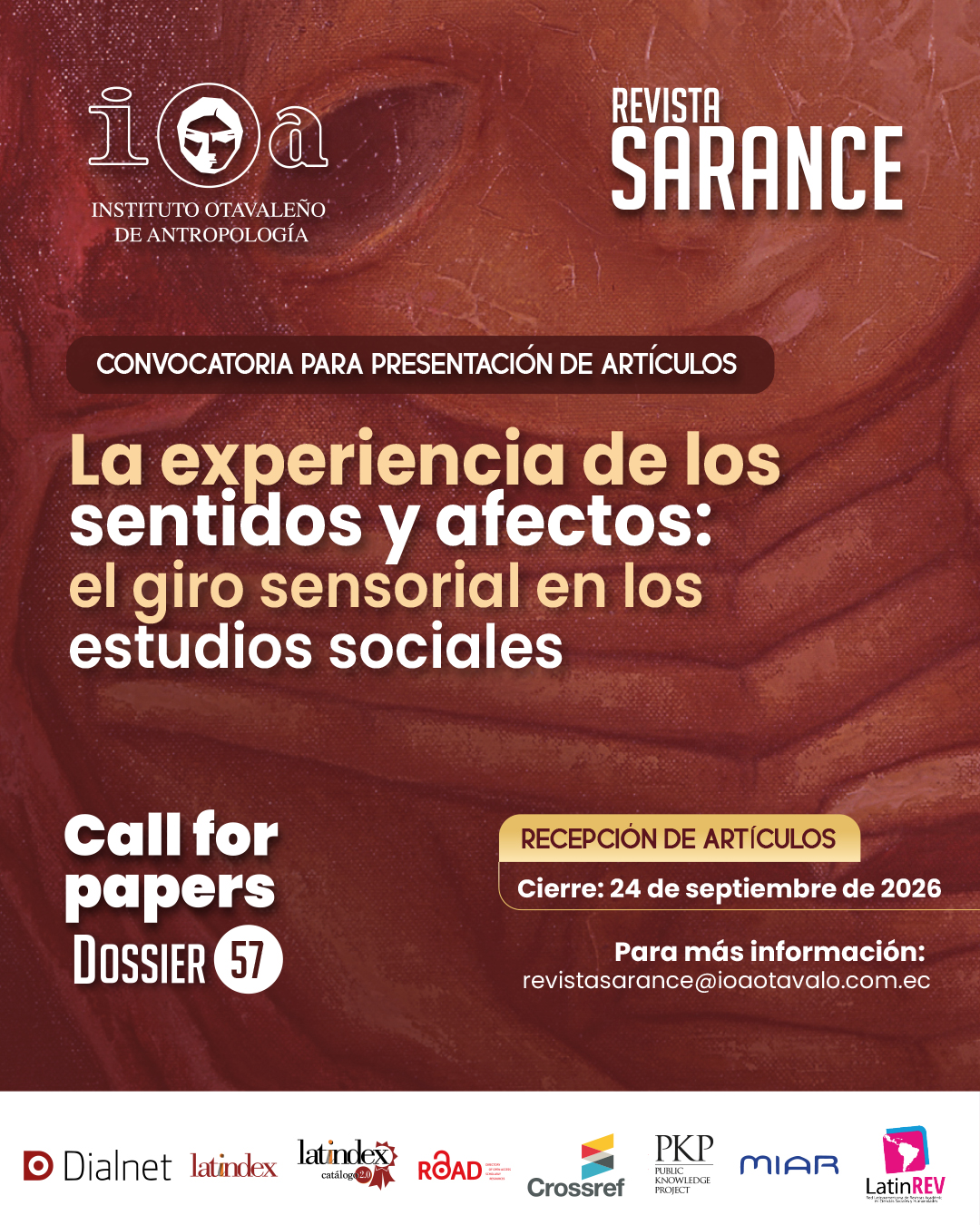
Call For Papers
Since the second half of the 20th century, anthropology shifted its interest away from the senses, largely due to the dominance of cognitive anthropology—which understood culture as mental models—and, later, Geertz’s interpretive anthropology. Although the reflexive turn in the 1980s sought to make the researcher’s position transparent, sensory anthropology proposed incorporating sensibility (or sensitividad) and reclaiming the body as a central locus of experience and knowledge production. This shift moved the understanding of culture from language and cognition toward the body as a fundamental site of experience.
The interest in the senses is not exclusive to anthropology. Psychology and neurology have traditionally studied them as individual cognitive processes, while the history of the senses—from authors like Alain Corbin to studies on «sensory cultures»—has shown that perception is also a historical construction, modulated by social, moral, and technological transformations. Similarly, the sociology of the body and emotion studies have demonstrated that feeling is a profoundly social act. Both sensory experience and the construction of affects are produced within collective frameworks: they are learned, regulated, and expressed in relation to social norms, imaginaries, and interactions. Affects are not mere internal states but relational forces that circulate between bodies, build bonds, intensify belongings, and organize forms of coexistence and conflict.
On the philosophical plane, Maurice Merleau-Ponty provided a decisive understanding by situating perception within the phenomenology of the lived body. His notion of corporeality (or corporeidad) breaks with Cartesian dualism and posits that to perceive is always to be-in-the-world in an incarnated manner. These ideas have extensively engaged with Deleuze’s critiques of the body as an object separate from the subject, fostering perspectives that conceive of it as an integrated unit of affects, movements, and potentialities.
The journal provides authors with the following resources:
A guideline template in Word format, designed to facilitate the preparation and submission of manuscripts.
The Authorship, Good Practices, and Copyright Transfer Declaration, a mandatory document that must be attached at the time of submission.
Key Dates
Submission Deadline: September 24th, 2026
Publication Date: December 2026
Article Publication
In the Sarance Journal, all submitted works undergo a rigorous double-blind peer review process. This procedure ensures the academic quality and editorial integrity of each published article.
As a general rule, Sarance Journal adheres to the citation guidelines of the American Psychological Association (APA, 7th edition), widely recognized in the academic field.
The review, editing, and final approval process is conducted via email, ensuring clear communication at each stage from initial submission to publication.
 Instituto Otavaleño de Antropología